

CINCINNATI — Joe Burrow has always had an urgency to be at his best.
This year, it’s just that he’s expected the rest of his teammates in the locker room to feel the same way.
That’s what this week’s comments were really all about when asked if he feels like the defense is good enough to help this team win a Super Bowl.
“I certainly think so,” Burrow said. “I think we have to step up and make something happen this year. We’re working really hard for it, the urgency is very high in the locker room, you can feel it. It’s palpable. We have to be more consistent on offense. Our standard is so high, but it’s so high because of what we’ve done and what we can do. And so I’m going to push that, and we’re going to keep getting better and see where we’re at in Week 1.”
Now or never, he was asked.
“That’s how I’m treating it for sure,” Burrow answered.
You can’t blame Burrow – in this day and age of manifesting – for putting it out to the universe as everyone is wont to say.
“I’m trying to put it out. I’m trying to put it out to the world. I’m trying to manifest it,” Burrow acknowledged. “I’m trying to show our guys the urgency that I have and that I want us to have as an organization to go and make it happen. You can keep pushing down the road, or you can talk about it now and say this is the year. I’m tired of saying next year, next year, next year. This is it. Your life is too short to keep pushing things down the road and trying to instill some urgency and some intensity in everybody to go and be great every day and try to go make it happen.”
Burrow spoke in May about the desire to be “meaner” if that’s what it takes to convince his teammates of the urgency this year. On Thursday, he took a more cerebral and metaphysical approach, joining Dax Hill and Jonathan Allen, who have also addressed the team.
“I don’t know if it’s necessarily catching on or following or just feeling it themselves,” Burrow said. “The veteran guys have all tried to do it in their own way. Dax and Jonathan have both spoken up in front of the team about it and I more so do it with my actions and individual conversations. But everybody feels that, all the veterans that have come in and that have been here feel it and want to do it.”
Burrow suggested at the start of camp in late July that this team reminds him of his 2019 LSU national championship team. What does it take to win a championship in Burrow’s mind?
“You’ve got to have a really close-knit team. You’ve got to have a team that trusts each other,” Burrow re-iterated Thursday. “You’ve got to have a team that wants to go to war for each other and fight for each other, and wants to hang out off the field, wants to play games in the locker room, and wants to sit with each other at lunch and have deep conversations. You have to have great players and great coaches, obviously, but that’s not necessarily … A lot of teams have great players and great coaches, but that’s not necessarily what does it.”
Of course, this is all true and has been. When you’re in the eye of the storm like fans, media, coaches, players and personnel executives, this is really not a big deal. It’s all obvious. On the outside, it looks like this huge storm of Burrow threatening the organization with a “win or else.”
To suggest that Burrow is suddenly showing a “new” level of urgency or an altered mindset toward his football career fundamentally misunderstands everything he has put on tape since his days at LSU. Burrow hasn’t suddenly discovered a burning desire to win; he has simply remained the same maniacally competitive quarterback he has always been, while a breathless media landscape scrambles to turn standard training camp focus into a groundbreaking revelation.
The Manufactured Drama of Burrow’s Comments
Every summer, NFL pundits latch onto a specific narrative arc, and this year, Burrow’s “urgency” is front and center of that arc. When Burrow speaks about tracking his progress, maximizing his windows, or adjusting his daily routine to ensure longevity, the national media spins it as an existential awakening. It is a silly exercise in over-analysis. Burrow’s comments aren’t a departure from his past identity; they are the logical extension of it. The idea that Burrow needed a wake-up call, or that his dedication to a championship was somehow dormant until this summer, ignores the physical and mental price he has repeatedly paid for the Cincinnati Bengals. This is a player who took a franchise from the top of the draft to a Super Bowl appearance while playing behind a porous offensive line, absorbing historic amounts of punishment without complaint. To question his competitive drive or to frame his focused demeanor as a novel development is entirely absurd.
Burrow’s perspective exposes the core flaw in the national commentary: confusing a mature evolution in physical preparation with a sudden shift in desire. He doesn’t need to prove his commitment to winning; his entire career trajectory serves as the ultimate proof. The external hype surrounding his quotes says infinitely more about the media’s need for dramatic storylines than it does about Burrow’s actual approach to the game.
Other items picked up this week:
Josh Newton’s Pivotal Stretch
While the national media focuses its cameras on the starting quarterback, the real substance of the Bengals’ roster construction is being forged in the lower tiers of the depth chart. The past week has carried immense significance for third-year cornerback Josh Newton, who has found himself thrust into high-stakes reps during critical installation phases and preseason evaluations.For a young defensive back, the transition from college to the NFL is defined by micro-moments—how quickly a player recovers from a beaten rep, how fluidly they pass off coverages in match-zone principles, and how they handle the mental load of a complex playbook. Newton’s week was a trial by fire, forcing him to match up against elite receiving talent in practice while operating under the intense scrutiny of the coaching staff.
Newton has shown flashes in the last week of camp, picking off Joe Flacco in practice on Tuesday, and several plays on second-team defense on Thursday. He’s also a new dad, a proud papa to Legend Zaire Newton last week.
“Everything I do now is for him. It doesn’t matter how I feel, just got to get it done,” Newton told me.
As for his competition with the likes of Ja’Sir Taylor, DJ Ivey and Bralyn Lux, Newton said he welcomes that. “Competition is everything in this league, like that is the NFL.”
Newton’s performance over the last seven days has offered the Bengals’ front office a glimpse of his ceiling. He showed flashes of tight, physical press coverage, showcasing the aggressive trail technique that made him an intriguing draft prospect. More importantly, his ability to diagnose diagnostic route concepts in real-time signaled that the game is beginning to slow down for him. In a secondary that requires versatile, disciplined depth to combat the explosive passing offenses of the AFC North, Newton’s developmental surge over the past week provides the coaching staff with a reliable, competitive option they can confidently rotate into specific sub-packages.
The Dexter Lawrence Effect on the Defensive Front
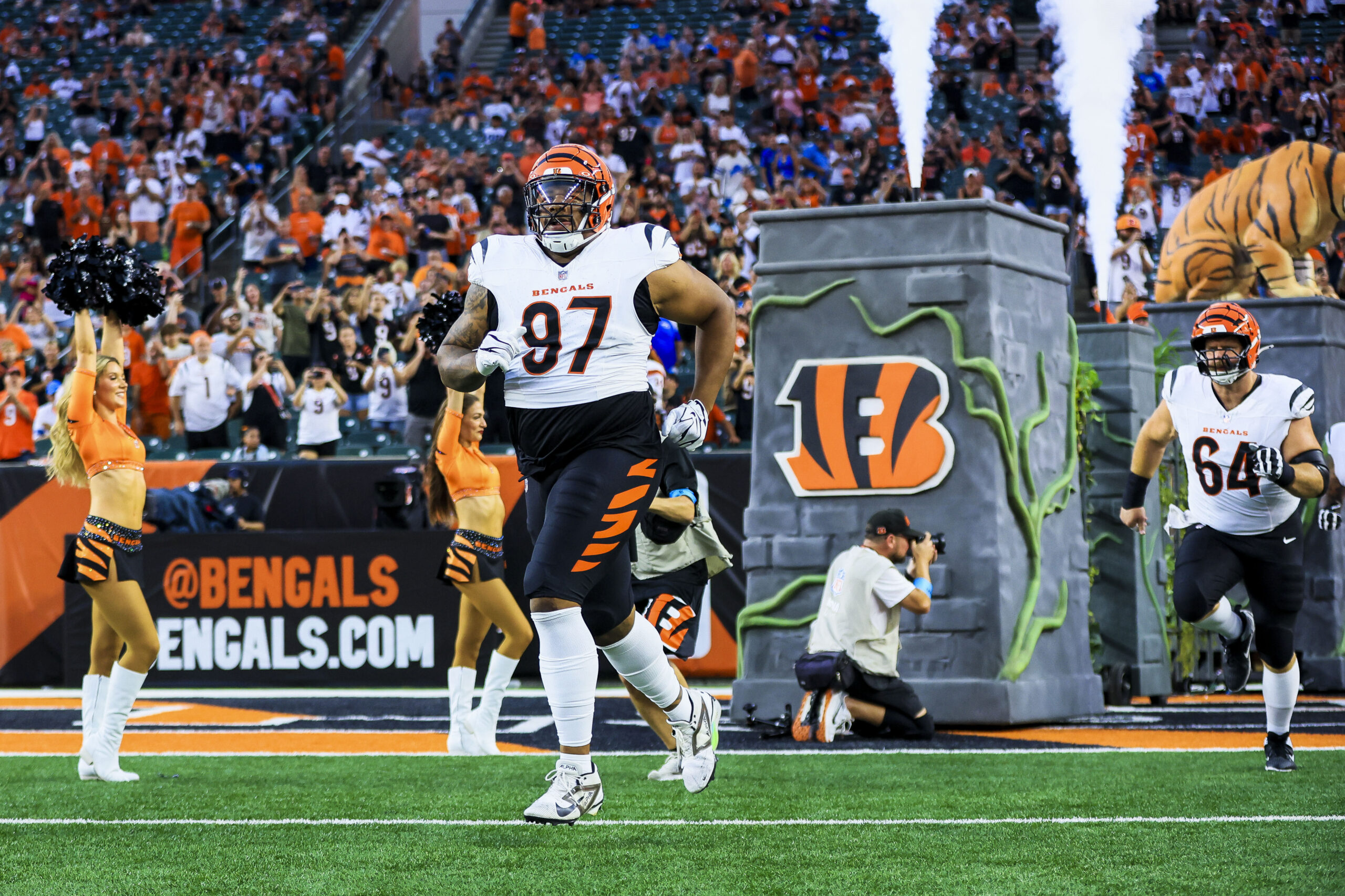
On the other side of the ball, the Bengals’ defensive identity is undergoing a powerful transformation, anchored by the arrival of superstar defensive tackle Dexter Lawrence II. While Lawrence’s individual dominance as a space-eating, pocket-collapsing force is well-documented, the true measure of his impact lies in how his presence elevates the players operating around him.
An elite interior defender changes the mathematical equations an opposing offensive line can utilize. You cannot single-block Lawrence without risking immediate interior penetration, yet devoting a constant double-team leaves gaps elsewhere. This structural advantage is creating a cascading effect across the entire Bengals defensive front, allowing edge rushers and situational blitzers to operate with unprecedented freedom.
Murphy had back-to-back sacks Thursday at the end of practice and another pressure to force an interception, prompting TJ Slaton to shout, ‘I see you 9-9!'” Murphy’s jersey number.
“I feel that’s what we are just across the board,” Murphy said. “Like whether whoever’s on the field, we’re gonna be cheering each other on because we, we all know across the board we can win, we can dominate on third downs, we can versus the passes. So I mean, whether it be first, second, third string, whoever, just just call a number, we expect the same thing.”
The beneficiaries of this interior gravity aren’t limited to established veterans. Young, dynamic pass-rushers are finding cleaner lanes and more favorable matchups because opposing protections are entirely hyper-focused on stopping Lawrence from ruining the play from the inside out. Rookie edge rusher Cashius Howell has felt the immediate benefits of this defensive synergy during his integration into the team’s passing-down packages.
“As a younger guy trying to find my rhythm and use my speed, playing alongside a dominant force like Dexter is a massive blessing,” Howell said. “The offense has to dictate so much attention to the inside that it gives me true one-on-one opportunities on the perimeter. If they slide the protection toward Dex, I get a clean runway. It allows me to play fast, trust my traits, and hunt without overthinking the design.”
Lawrence himself views his role not just as an individual disruptor, but as the foundational anchor designed to maximize the collective unit. His leadership style is reflected in how he demands excellence from the young players filling out the rotation around him. Of course, it doesn’t hurt when he’s making plays like he did at the end of practice Thursday, reading a screen pass, tipping the ball up in the air to himself and catching it for an interception.
“It was obviously a screen. We were able to get some pretty quick pressure on the quarterback to where he kind of hesitated a little bit, and we had got there,” Howell said. “We got somebody in the back end to get a tip on it, and that led to Dex getting his interception. So just collectively as a unit, we just all kind of gelled together, and you know we’re able to make a good play at the end.”
“Throughout the day they were running screens, and they were getting some good yards off it, and I felt that same feeling, and saw Caleb drifting, and I saw the running back to like like kind of run like a screen route, so I just drifted to the side and and tipped it and caught it.”
With the two Murphy sacks and the Davis interception after the Lawrence pick, it was the strongest finish to practice possible.
“It’s more the players knowing the situation of the game and knowing how important it is and taking advantage of it,” Lawrence said.
Kind of like what Burrow has been saying all along.
When you strip away the tired, manufactured narratives surrounding Burrow’s press conferences, the reality of the 2026 Bengals becomes clear. This is a football team anchored by a quarterback who has always possessed an elite competitive drive, now supported by a defensive overhaul designed to match that standard. The Bengals need not win games in the media room with quotes or manufactured summer storylines; they are building a balanced, physical contender on the practice fields, designed to peak when the games matter most. That’s the plan, anyway.

